

Shanghai Qixuan Chemical Technology Co., Ltd., a specialist surfactant manufacturer, supplies products widely used in cleaning, oilfield, agrochemical emulsion, asphalt, mineral processing and other industries. Recently, the company introduces Splitbreak 254, a demulsifier designed for multi-industry interfacial separation challenges.
Industry Challenges
At oilfield gathering stations, cleaning waste liquid treatment workshops, emulsified asphalt production lines and mineral processing tailing slurry tanks, process engineers frequently face the same headache: demulsifier dosage keeps rising, while dehydration performance cannot be improved. Poor water clarity, excessive water-in-oil and oil carry-over in water repeatedly exceed standards, and stable intermediate emulsion layers keep building up.
The Splitbreak Solution
Splitbreak 254 is developed to tackle this issue from the molecular interfacial mechanism. It enables demulsifier molecules to rapidly reach the oil-water interface and break the stable interfacial film, rather than remaining ineffective within the bulk phase.
1. The Core Bottleneck of Demulsification: The Tough Interfacial Film
Crude oil produced fluid, alkaline cleaning waste liquid, emulsified asphalt and flotation tailing slurry are all complex emulsion systems consisting of dispersed droplets, tough interfacial films and continuous media. Asphaltenes, resins, naphthenic acids, residual surfactants and polymeric flocculants accumulate at the interface, forming an elastic protective layer that tightly locks dispersed droplets and prevents coalescence.
The fundamental mechanism of demulsifiers is straightforward: they migrate to the oil-water interface, displace native natural emulsifiers, reduce interfacial tension, weaken the mechanical strength of the film, and allow droplets to collide, coalesce and settle for phase separation. The real challenge lies in the variable interfacial composition of field emulsions. A simple single-structure polyether can hardly achieve fast spreading, effective film rupture and clear separated water at the same time.
A common field practice is to increase the dosage of conventional demulsifiers. It may deliver marginal dehydration at the initial stage, yet usually leads to turbid separated water, thick emulsion rag layers and heavier load for downstream wastewater treatment.
2. Molecular Design: Multi-Anchor Skeleton
The primary active component of Splitbreak 254 is ethoxylated and propoxylated tert-butylphenol-formaldehyde resin polyether (CAS No. 30704-64-4), accounting for 50–70% of the finished product.
Structural Advantages
The phenolic resin backbone provides multi-point anchoring capacity. Aromatic rings interact with asphaltene and resin laminates via van der Waals force and π-π interaction.
EO/PO Copolymer Segments
By controlling the ratio and sequence, the hydrophilic-lipophilic balance, interfacial spreading speed and aqueous solubility can be precisely tuned.
Its Relative Solubility Number ranges from 8.5 to 9.5, indicating an oil-biased property suitable for W/O emulsions.
3. Physical and Chemical Specifications
| Parameter | Specification |
|---|---|
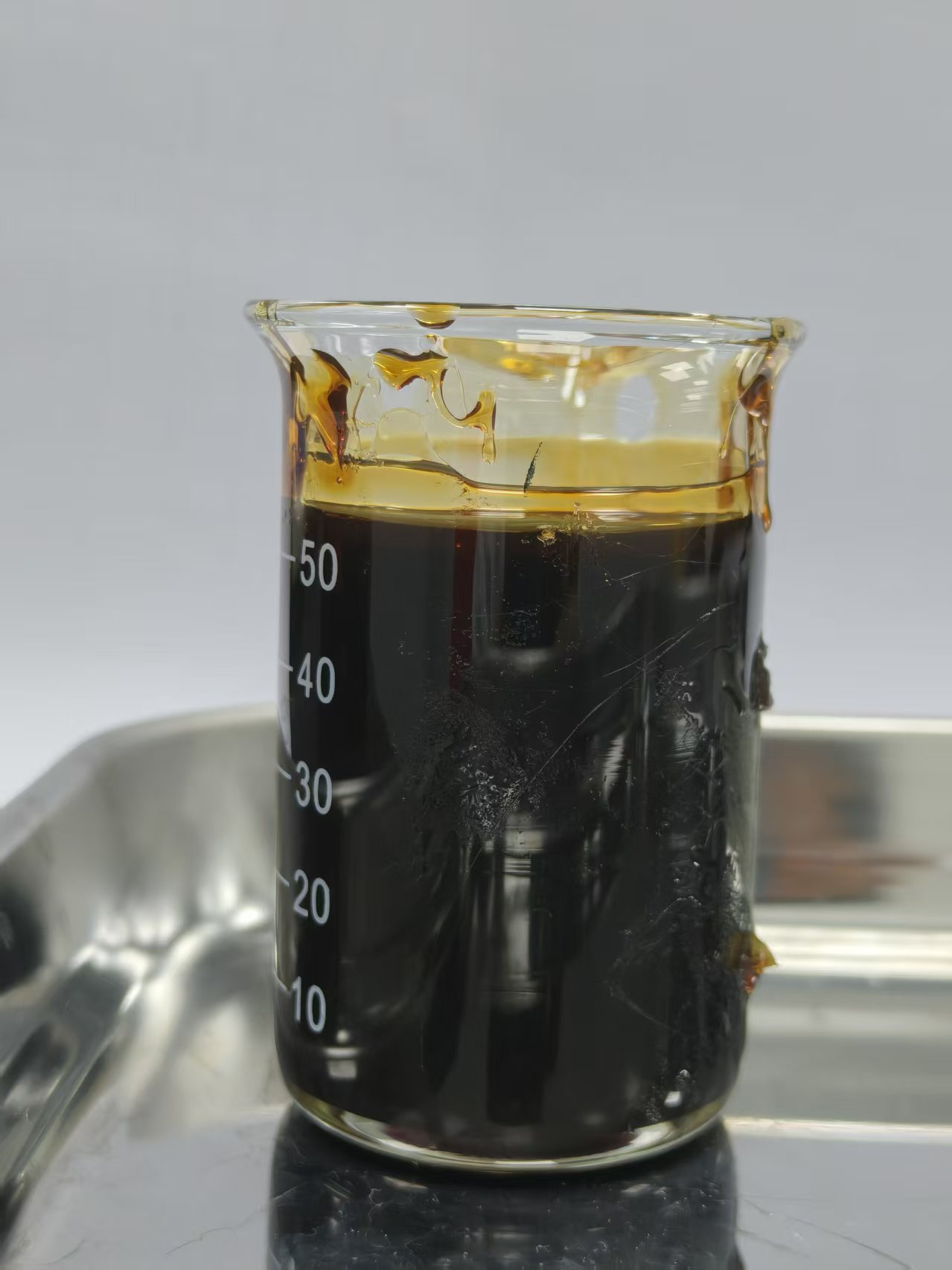
| Appearance (25 °C) | Amber dark liquid |
| Moisture Content | ≤ 0.2% |
| pH Value (5% solution) | 9.0 – 11.0 |
| Relative Solubility Number | 8.5 – 9.5 |
| Flash Point | 30 °C |
4. Four Core Application Fields
• Oilfield
Primary Agent for Crude Oil Dehydration and Desalting. Balances dehydration rate and water clarity.
• Cleaning Industry
Promotes floating separation of emulsified oil, extends service cycle of cleaning baths.
• Asphalt Industry
Adjusts demulsification speed and treats residual interfacial emulsifiers.
• Mineral Processing
Improves solid-liquid separation efficiency, reducing filter cake moisture.
5. Practical Operation Guidelines
• Bottle tests: Prepare dosage gradients (10-500 ppm) at 45–80 °C to eliminate blind dosing.
• Dilute solution: Pre-dilute with alcohols or aromatic solvents for convenient metering.
• Injection point: Prioritize points before wellheads or static mixers for 30–60 seconds of mixing.
6. Compliance and Safety Reminders
Splitbreak 254 contains heavy aromatic solvent naphtha (H227, H336, H304, H401, H411). The flash point is 30 °C. Handle as a flammable liquid. Use protective gear (gloves, goggles). Discharge to sewer is prohibited. Refer to SDS for full info.
7. Evaluation System & Conclusion
Qixuan Chemical provides professional lab testing services including interfacial tension measurement and bottle dehydration tests to convert empirical parameters into technical indicators.
Demulsification success never comes from blindly increasing chemical dosage. Splitbreak 254 represents Shanghai Qixuan Chemical Technology’s achievement in interfacial chemistry.
For sample request and technical support, please contact Shanghai Qixuan Chemical Technology Co., Ltd.
Post time: Nov-17-2026