

Fineness Requirements
General Industrial Cleaning, Precision Industrial Cleaning and Ultra-precision Industrial Cleaning
General industrial cleaning involves cleaning the surfaces of vehicles, ships and aircraft, which can only remove relatively coarse dirt.
Precision industrial cleaning covers cleaning during the processing of various products and cleaning the surfaces of diverse materials and equipment, characterized by its capacity to eliminate tiny dirt particles.
Ultra-precision industrial cleaning refers to the ultra-precise cleaning of mechanical parts, electronic components, optical parts and other items in precision manufacturing processes, with the goal of removing extremely minute dirt particles.
Cleaning Methods
Physical Cleaning and Chemical Cleaning
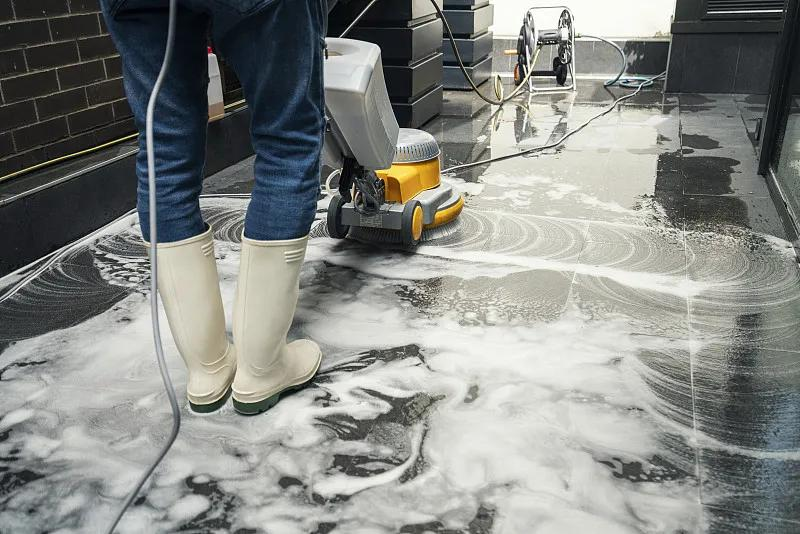
Physical cleaning adopts the principles of mechanics, acoustics, optics, electricity and thermodynamics. Relying on external energy such as mechanical friction, ultrasonic waves, negative pressure, high pressure, impact, ultraviolet rays and steam, it removes dirt on object surfaces without altering the chemical composition of contaminants, meaning the original chemical molecular structure remains unchanged.
① Mechanical cleaning methods: sweeper and scraper cleaning, tube drilling cleaning, shot blasting cleaning.
② Hydraulic cleaning: low-pressure hydraulic cleaning with a pressure ranging from 196 to 686 kilopascals, approximately 2 to 7 kilograms-force per square centimeter, equivalent to 0.2 to 0.7 MPa.
③ High-pressure hydraulic cleaning: the pressure for high-pressure cleaning reaches 4900 kilopascals, around 50 kilograms-force per square centimeter, equal to 5 MPa. This method is also known as high-pressure water jet cleaning and is implemented via high-pressure cleaning machines.
Chemical cleaning removes surface dirt from objects through chemical reactions using chemical agents or other solvents. Examples include eliminating rust and limescale with various inorganic or organic acids, and removing surface stains with oxidants. Chemical agents react with surface contaminants or covering layers (such as scale deposits) to strip them away, including acid washing and alkaline washing for scale removal. To prevent substrate corrosion during chemical cleaning or control the corrosion rate within permissible limits, an appropriate amount of corrosion inhibitors and additives with activating, penetrating and wetting properties are usually added to chemical cleaning solutions.
Cleaning techniques;immersion method, circulation method, on-line cleaning method (also called non-stop chemical cleaning method).
Electronic anti-scaling and descaling principle: high-frequency electric fields restructure water molecules to achieve anti-scaling and descaling effects. When water passes through a high-frequency electric field, its physical molecular structure changes. Original associated chain macromolecules break down into single water molecules. Positive and negative ions of salts dissolved in water are surrounded by individual water molecules, which reduces their movement speed, lowers the frequency of effective collisions and weakens electrostatic attraction. The ions can no longer aggregate on heated walls or pipe surfaces, thus preventing scale formation. Meanwhile, the increased dipole moment of water molecules strengthens their binding capacity with positive and negative salt ions (limescale molecules), softening limescale on heated surfaces and pipe walls for easy detachment and descaling.
Static anti-scaling and descaling achieves the same goals as electronic descaling by modifying the state of water molecules, though it relies on electrostatic fields instead of electronic effects. The mechanism lies in the polarity (dipole property) of water molecules. When water dipoles pass through an electrostatic field, they align continuously and orderly by positive and negative charges. Dissolved salt ions in water are enveloped by water dipoles and arranged sequentially within dipole clusters, restricting their free movement and preventing them from approaching or depositing on pipe/equipment walls to form limescale. Additionally, oxygen released in water forms an extremely thin oxide film on pipe walls to mitigate wall corrosion.
Cleaning Media
Wet Cleaning and Dry Cleaning
Cleaning carried out in liquid media is generally defined as wet cleaning, and most traditional cleaning approaches fall into this category.
Cleaning conducted in gaseous media is classified as dry cleaning, including laser cleaning, ultraviolet cleaning, plasma cleaning and dry ice blasting cleaning.
Corrosion Inhibitors
A corrosion inhibitor is a substance added in small quantities to corrosive media that drastically slows metal corrosion. This metal protection technique is known as corrosion inhibitor protection.
Classification of Corrosion Inhibitors
By mechanism of action: anodic inhibitors, cathodic inhibitors, mixed-type inhibitors
By protective film characteristics: oxidizing film-forming inhibitors, adsorption-type inhibitors, precipitation film-forming inhibitors
Other classification criteria:
① Organic and inorganic corrosion inhibitors
② Liquid-phase, gas-phase and solid-phase corrosion inhibitors
③ Corrosion inhibitors for steel, copper and aluminum
④ Acidic, alkaline and neutral corrosion inhibitors
Cleaning Objects
Pre-commissioning Cleaning, Non-stop Cleaning and Shutdown Maintenance Cleaning
Pre-commissioning Cleaning
New chemical equipment must undergo chemical cleaning and passivation before commissioning. Practice has proven that pre-startup chemical cleaning and passivation deliver significant benefits to production safety and economic efficiency, generating substantial economic returns.
Purposes of Pre-commissioning Cleaning and Passivation
Mill scale forms on raw metal materials such as steel pipes, steel plates and stainless steel during rolling. Rust, welding slag, oily rust preventatives applied to steel for corrosion protection, dust, sand, cement, thermal insulation materials and other impurities accumulate on equipment during manufacturing, transportation, storage and installation. As equipment capacity expands, the time span from the production of steel pipes and plates, through equipment fabrication, logistics and installation to final commissioning lengthens. More welding joints and larger heated surfaces lead to increased total volume of contaminants including mill scale, rust, welding slag, rust preventatives and sediment.
After cleaning, a dense chemical passivation film forms on clean metal surfaces. This film effectively inhibits reoccurrence of dirt and provides reliable protection for equipment against corrosion and other chemical damage.
Non-stop Cleaning
Some chemical equipment cannot halt operation for maintenance and cleaning during production, which spurred the development of non-stop cleaning technology. Mature domestic non-stop cleaning solutions enable chemical cleaning and passivation while equipment remains operational, safeguarding stable equipment operation and service efficiency.
Shutdown Maintenance Cleaning
Shutdown maintenance cleaning refers to cleaning operations performed on all equipment during the annual scheduled overhaul period of chemical enterprises. Typically, single units undergo circulating chemical cleaning or high-pressure water jet cleaning during shutdown maintenance.
Post time: Jul-07-2026