

During surfactant selection meetings, a common challenge often arises: two fatty amine polyoxyethylene ethers with only a slight difference in ethylene oxide (EO) units and similar price tags can deliver remarkably different outcomes once incorporated into practical formulations. The emulsion stability, system viscosity and even finished product color will change visibly. In serving customers across cleaning, oilfield, agrochemical emulsification, asphalt, mineral processing and other sectors, the technical team of Shanghai Qixuan Chemical Technology Co., Ltd. is frequently asked one core question: how to select the proper EO number?
TA05, namely tallow amine polyoxyethylene (5) ether, offers a representative solution to this question. It does not pursue extreme performance on a single indicator, yet finds its reliable position in a wide spectrum of highly diverse application systems.
Basic Profile of TA05
TA05 is synthesized by ethoxylation of natural tallow amine with 5 EO units, CAS No. 61791-26-2. Its hydrophobic segment consists of mixed long C16–C18 alkyl chains, while the hydrophilic part is jointly contributed by five EO units and a protonatable amine group.
This unique structure endows it with dual functional identities. Under neutral or alkaline conditions, it functions as a nonionic surfactant, realizing emulsification and dispersion via hydration of EO chains. In acidic environments, the amine group gets protonated and carries positive charges, exhibiting cationic surfactant characteristics with strong adsorption affinity toward negatively charged substrates including metal surfaces, minerals, fibers and asphalt particles. This dual working mechanism within one molecule lays the fundamental reason why TA05 is repeatedly adopted across multiple industries.
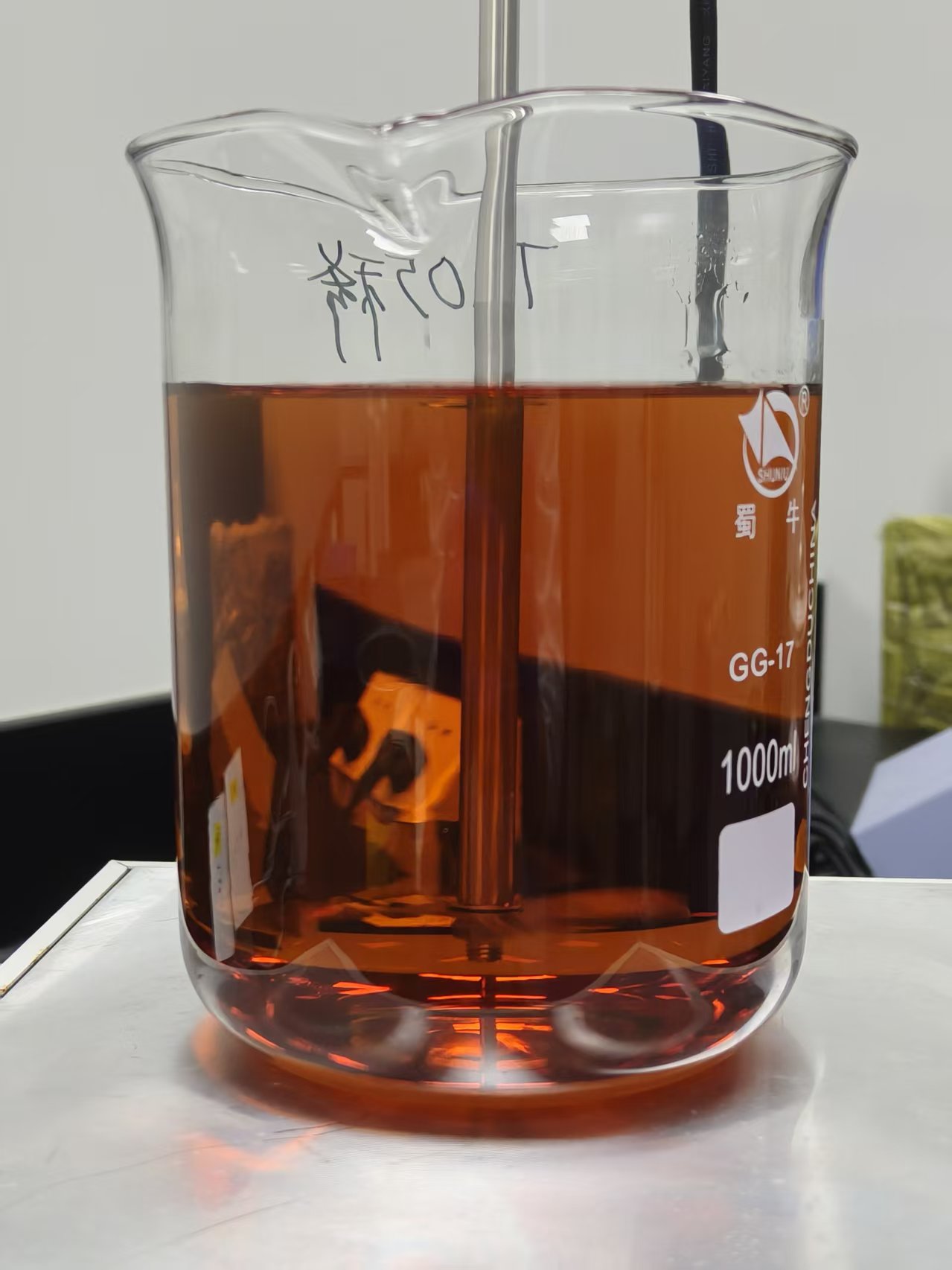
In terms of physical properties, TA05 appears as pale yellow to brown viscous liquid at 25°C. Its 1% aqueous solution is alkaline with pH ranging from 9 to 11. The total amine value is normally controlled between 110–120 mgKOH/g, moisture ≤1.0%, Gardner color ≤10, and the HLB value is approximately 9. This HLB sits right at the boundary between hydrophilicity and lipophilicity, enabling it to dissolve well in oil phases while migrating toward oil-water interfaces. It is therefore suitable for W/O emulsification, co-emulsification and interfacial wetting, rather than serving as a simple oil-in-water emulsifier.
Why 5 EO Units?
A single tallow amine feedstock can be ethoxylated into serial grades with 2, 5, 10, 15 EO units, delivering gradually varying properties. Lower EO counts bring stronger lipophilicity, higher amine value and poorer water solubility; higher EO contents improve water solubility and shift emulsifying preference toward O/W systems.
The 2 EO grade is excessively oil-soluble, requiring solvent dilution or heating for dispersion in many formulations. Grades with 10 or more EO units show much better water solubility yet weakened interfacial affinity in high-oil, high-solid-content systems. Five EO units strike a balanced middle ground: it retains sufficient lipophilic segments to anchor onto oil, asphalt and mineral surfaces, meanwhile possessing basic hydrophilic capacity for spreading in aqueous media. For applications demanding both emulsification and adsorption, balancing lipophilicity and water dispersibility, this grade frequently outperforms grades on either end of the EO spectrum.
That also explains why TA05 is widely regarded as a “formulation connector”. Its water solubility and cloud point can be tuned by blending with higher-EO analogues, while lipophilic performance can be boosted by combining with low-EO variants. In compound systems, it acts as a flexible building block for formulation adjustment, often more valuable as a co-component than a standalone primary agent.
Practical Functions Across Four Core Application Segments
TA05 works as a primary component or blending ingredient for corrosion inhibitors. The amine group and EO chains adsorb onto metal surfaces to form a protective film, isolating corrosive media from pipeline substrates. It also serves as a lipophilic emulsifying additive for heavy oil viscosity reduction, demulsification aids and drilling fluid emulsifiers.
In agrochemical EC, EW and ME formulations, TA05 acts as emulsifier and dispersant to facilitate uniform spreading of active ingredients at oil-water interfaces. When compounded with anionic emulsifiers such as calcium dodecylbenzene sulfonate, special attention should be paid to anionic-cation incompatibility.
Within cationic asphalt emulsifier systems, the long alkyl chain of TA05 shows excellent compatibility with asphalt fractions. It helps reduce phase separation and improve storage stability. It can also be used as an interfacial wetting additive in modified asphalt.
For heavy-duty degreasing, TA05 is usually compounded with higher-EO nonionic surfactants or anionic surfactants to strip greasy contaminants and optimize rinsing performance. In metalworking fluids, its main contributions are corrosion inhibition and emulsion stabilization.
Besides the above sectors, it can be deployed as antistatic and softening additive in textile processing by adsorbing onto fiber surfaces via protonated amine groups. In mineral flotation, it functions as a collector auxiliary or dispersant relying on directional cationic adsorption on mineral surfaces.
Consistent Batch Performance Matters
For fatty amine ethoxylates, meeting specification thresholds is merely the entry requirement. What truly governs formulation stability for end customers is narrow EO distribution, controlled free PEG and free EO content, and stable color over storage. Broad EO distribution will lead to fluctuating emulsifying capacity and water solubility even with identical amine values. Formulations optimized at lab scale tend to fail during pilot or full production scale-up.
At Qixuan, core control indicators for TA05 cover amine value, moisture, pH and color, with full batch testing and sample retention for traceability. Standard packaging is 180 kg per drum, while IBC tote and customized OEM packaging are available upon request.
Three Practical Guidelines for Formulation
- [1] Define pH window before compatibility evaluation: TA05 behaves as cationic under acidic conditions and nonionic under alkaline conditions. Its compatible partners, feeding sequence and recommended dosage differ drastically between these two environments.
- [2] Avoid direct bulk mixing with anionic surfactants: When co-formulated with anionic species, intermediate nonionic surfactants or separate feeding sequences are recommended to prevent local high concentration and precipitate formation.
- [3] Control feeding temperature: TA05 features high viscosity, especially under low-temperature winter conditions. Preheating to around 60°C before dosing facilitates accurate metering and prevents uneven local emulsification.
Closing Remarks
Surfactant selection is essentially locating the optimal point along a continuous EO tuning curve. The merit of TA05 does not lie in supreme performance on one single property, but occupying that often-overlooked intermediate zone balancing lipophilicity and hydrophilicity with abundant practical market demands.
Shanghai Qixuan Chemical Technology Co., Ltd. supplies a complete series of tallow amine polyoxyethylene ether grades. We are ready to provide tailored EO variants and professional application technical support matching your specific formulation requirements.
Post time: Nov-12-2026