

As we all know, the sounds people hear are acoustic wave signals with a frequency ranging from 20 Hz to 20,000 Hz. Acoustic waves with a frequency higher than 20,000 Hz are called ultrasonic waves. Acoustic waves propagate longitudinally in the form of a sine wave, alternating between strong and weak as they travel. When weak acoustic wave signals act on a liquid, they generate a certain negative pressure inside the liquid, forming numerous tiny bubbles. In contrast, strong acoustic wave signals exert positive pressure on the liquid, causing these tiny bubbles to collapse. Studies have shown that when ultrasonic waves act on a liquid, the collapse of each bubble produces extremely powerful shock waves, accompanied by instantaneous high temperatures and pressures of up to thousands of atmospheres. This phenomenon is known as the “cavitation effect”. Ultrasonic cleaning leverages the shock waves generated by the bursting bubbles in liquid to clean and scour both the internal and external surfaces of workpieces.
Ultrasonic waves can be divided into three categories: infrasonic waves, sound waves and ultrasonic waves. The frequency of infrasonic waves is below 20 Hz, that of sound waves ranges from 20 Hz to 20 kHz, and ultrasonic waves have a frequency above 20 kHz. Generally, the human ear cannot detect infrasonic waves and ultrasonic waves. Thanks to their high frequency and short wavelength, ultrasonic waves feature good directional propagation and strong penetration capability.
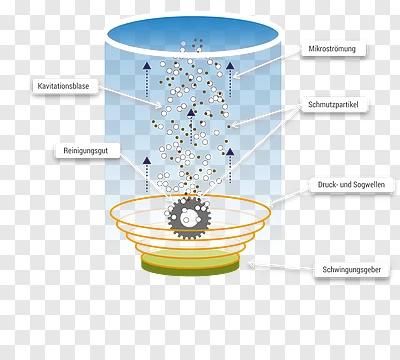
The working principle of an ultrasonic cleaner is as follows: the transducer converts the acoustic energy from the high-power ultrasonic frequency source into mechanical vibration. This vibration is transmitted through the wall of the cleaning tank, radiating ultrasonic waves into the cleaning solution inside the tank. Under the irradiation of ultrasonic waves, tiny bubbles in the liquid keep vibrating under the effect of sound waves.
When the sound pressure or sound intensity reaches a certain level, the bubbles expand rapidly and then collapse abruptly. At the moment of bubble collapse, shock waves are generated, producing a pressure ranging from 10¹² Pa to 10¹³ Pa around the bubbles. The tremendous pressure created by ultrasonic cavitation breaks down insoluble contaminants and disperses them into the solution.
On one hand, ultrasonic waves break the adhesion between contaminants and the surface of cleaned objects. On the other hand, they cause fatigue failure of the contaminant layers, making them peel off. The vibration of gaseous bubbles scrubs solid surfaces. Once cracks appear in the contaminant layers, bubbles will penetrate into the gaps and vibrate to detach the dirt. Cavitation also enables rapid dispersion and emulsification of two liquids at their interface. When solid particles coated with oil adhere to the surface of cleaned items, the oil is emulsified and the solid particles fall off naturally. As ultrasonic waves travel through the cleaning solution, they generate alternating positive and negative sound pressure, forming jets that impact the cleaned objects. Meanwhile, non-linear effects produce acoustic streaming and micro-acoustic streaming, and ultrasonic cavitation creates high-speed micro-jets at the solid-liquid interface. All these effects can break down contaminants, remove or weaken the surface dirt layers, enhance stirring and diffusion, accelerate the dissolution of soluble dirt, and boost the cleaning performance of chemical detergents.
It can be concluded that cleaning takes place wherever the liquid can reach and the sound field exists. This technology is especially suitable for cleaning parts with extremely complex surface shapes. In addition, the application of this technology can reduce the usage of chemical solvents, thereby greatly alleviating environmental pollution.
Precautions for Using Ultrasonic Cleaners
The power supplies for the ultrasonic cleaner and its electric heater must be equipped with reliable grounding devices.
Do not operate the ultrasonic cleaner without cleaning liquid. Never turn on the ultrasonic switch if the cleaning tank is not filled with an adequate amount of cleaning solution.
For cleaning equipment fitted with heating units, the heating switch must not be activated when there is no liquid inside.
Do not strike the bottom of the cleaning tank with heavy objects such as iron parts, to prevent damage to the transducer chips.
The ultrasonic generator shall be connected to an independent 220V/50Hz power circuit, equipped with a voltage stabilizer rated at over 2000W.
Rinse the bottom of the cleaning tank regularly to avoid excessive debris and dirt accumulation.
When replacing the cleaning liquid, start the ultrasonic system first before placing items into the tank for cleaning.
Post time: Jun-12-2026