

To master and manage the oil removal process well, it is necessary to correctly grasp the principle of the bonding between the coating and the metal substrate. This point is often overlooked, thus bringing difficulties in practice.
Relevant materials point out that the mechanical bonding caused by the micro-roughness of the coating and the substrate surface is only strong when there is intermolecular and intermetallic force bonding between the coating and the metal substrate. Intermolecular and intermetallic forces can only manifest within a very small distance.
When the distance between molecules exceeds 5μm, the intermolecular force no longer works. Therefore, a thin oil film and oxide film on the substrate surface can also hinder the intermolecular or metallic bonding force.
In order to achieve the above-mentioned bonding, it is necessary to remove oil stains, rust and oxide scale from the products quite thoroughly. The “quite thorough” we refer to does not mean that the surface is required to be absolutely clean after pre-plating treatment, but only that it has a qualified surface. The so-called qualified surface actually means that the films that are harmful to electroplating must be removed after pre-plating treatment and replaced by films that are suitable for accepting electroplating.
At the same time, through pre-plating treatment, the metal surface is required to be absolutely flat. After mechanical treatments such as grinding, polishing, tumbling, sandblasting, etc., obvious scratches, burrs and other defects on the surface are removed, so that the substrate surface meets the requirements of substrate leveling and finish of the plated parts before oil removal and rust removal.
This point must be clear. Only when this point is clear can we correctly and practically select the pre-plating treatment process flow and formula among similar formulas for pre-plating treatment.
How to apply the degreasing process in production?
Alkaline degreasing is usually adopted. The composition of the degreasing solution and process conditions are selected according to the state of the oil stain and the type of metal material.
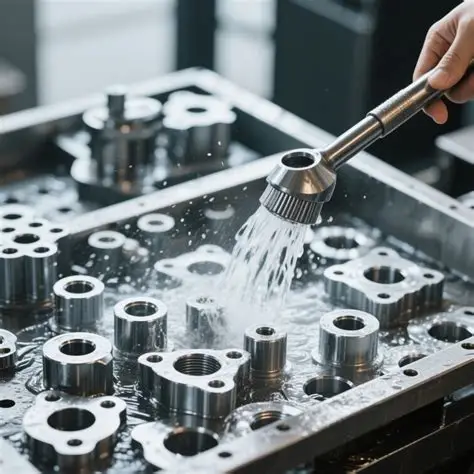
When there is a large amount of grease adhering to the surface, that is, the oil layer is very thick, with a greasy and sticky feeling, it cannot be easily removed only by alkaline degreasing. It is necessary to first use other methods such as brushing with solvent for degreasing pretreatment, and then perform alkaline degreasing. The alkaline degreasing solution is strongly alkaline, and it will cause obvious corrosion when reacting with some metals.
Therefore, when degreasing plated parts such as aluminum and zinc, it should be carried out under low-temperature and low-alkali conditions as much as possible. It is generally acceptable to treat steel parts with higher alkalinity, but when treating non-ferrous metal parts, the pH of the degreasing solution should be adjusted to an appropriate range. For example, aluminum, zinc and their alloys should have the pH controlled below 11, and the degreasing time for such products should not exceed 3 minutes.
From the perspective of cost, some advocate low-temperature degreasing, but reducing the temperature contradicts improving efficiency. The higher the temperature, the faster the physical and chemical reaction speed between the grease adhering to the surface and the cleaning agent, and the easier the degreasing.
Practice has proved that the viscosity of oil stains decreases as the temperature rises, so degreasing is easier to carry out, but low temperature does not have this effect. Therefore, it is considered to use emulsifiers and surfactants. As for whether high-temperature degreasing is good and what temperature is appropriate to control, the author’s experience is that 70-80°C is better. This can also help eliminate the residual stress of the base metal caused by machining, which is very beneficial to improve the adhesion of the coating, especially between multi-layer nickels.
General steel parts can adopt combined degreasing, such as first cathodic degreasing for 3-5 minutes, then anodic degreasing for 1-2 minutes, or first anodic degreasing for 3-5 minutes, then cathodic degreasing for 1-2 minutes. This can be achieved by two degreasing processes or using a power supply with a commutation device.
For high-strength steel, spring steel and thin parts, in order to prevent hydrogen embrittlement, only anodic degreasing is performed for several minutes. However, non-ferrous metal parts such as copper and copper alloys cannot use anodic degreasing, and only cathodic degreasing for 1-2 minutes is allowed.
In terms of the preparation and maintenance of the degreasing solution, the preparation of chemical degreasing and electrolytic degreasing solutions is relatively simple. First, use 2/3 of the tank volume of water to dissolve other materials except surfactants, and stir at the same time (to prevent the medicine from caking). Since these medicine materials release heat when dissolved, there is no need to heat them. Surfactants should be dissolved separately with hot water before adding. If they cannot be dissolved at one time, the upper clear liquid can be poured out and then water can be added for dissolution. Add to the specified volume and stir well before use.
Attention should be paid to the management of oil removal fluid:
① Regularly test and replenish materials. Surfactants should be replenished at 1/3 to 1/2 of the original amount weekly or biweekly according to production volume.
② The iron plates used should not contain excessive heavy metal impurities to prevent them from being introduced into the coating. The current density should be maintained at 5-10 A/dm², and its selection should ensure the sufficient evolution of bubbles. This not only ensures the mechanical detachment of oil droplets from the electrode surface but also agitates the solution. When the surface oil stain is constant, the greater the current density, the faster the degreasing speed.
③ Floating oil stains in the tank should be removed in a timely manner.
④ Regularly clean up sludge and dirt in the tank, and replace the tank solution promptly.
⑤ Try to use low-foam surfactants in the electrolyte; otherwise, their introduction into the electroplating tank will affect the quality.
How to master and manage the acid etching (pickling) process?
Like the degreasing process, acid etching (pickling) plays an important role in pre-plating treatment. These two processes are used in conjunction in pre-plating production, and their main purpose is to remove rust and oxide scales from metal plating parts.
Usually, the process used to remove a large amount of oxides is called strong etching, and the process used to remove thin oxide films that are barely visible to the naked eye is called weak etching, which can be further divided into chemical etching and electrochemical etching. Weak etching is used as the final treatment process after strong etching, i.e., before the workpiece enters the electroplating process. It is a process of activating the metal surface and is easily overlooked in production, which is precisely one of the reasons for electroplating peeling.
If the weak etching solution is one of the components of the next plating solution, or if its introduction will not affect the plating solution, it is better to directly put the activated plating parts into the plating tank without cleaning.
For example, with the dilute acid activation solution used before nickel plating, to ensure the smooth progress of the etching process, degreasing must be carried out before etching; otherwise, the acid and metal oxides cannot make good contact, and the chemical dissolution reaction will be difficult to proceed.
Therefore, to master acid etching well, it is also necessary to clarify these basic principles theoretically.
Usually, to remove the oxide scale from iron and steel parts, sulfuric acid and hydrochloric acid are mainly used for acid etching. The method is simple, but in actual production, it is difficult to achieve the expected purpose if not paid attention to.
The selection criteria for the etching process conditions of sulfuric acid are usually based on experience to identify from the appearance of the workpiece after pickling, which, after all, cannot be controlled quantitatively. Practice has shown that the effect of sulfuric acid pickling in removing oxide scales at 40°C is much greater than at 20°C, but when the temperature is further increased, the peeling effect does not increase proportionally.
At the same time, in sulfuric acid with a concentration lower than 20%, as the concentration increases, the acid etching speed accelerates, but when the concentration exceeds 20%, the acid etching speed decreases instead. For this reason, we believe that the standard process conditions of 10%-20% sulfuric acid concentration and etching below 60°C are more appropriate. It should also be noted that regarding the aging degree of the sulfuric acid solution, generally, when the iron content in the pickling solution exceeds 80 g/L and the ferrous sulfate content exceeds 2.5 g/L, the sulfuric acid solution can no longer be used.
At this time, the solution should be cooled to crystallize and remove the excess ferrous sulfate, and then new acid should be added to meet the process requirements.
The selection criteria for the acid etching process conditions of hydrochloric acid: the concentration should generally be controlled at 10%-20%, and the process should be carried out at room temperature. Compared with sulfuric acid, under the same conditions of concentration and temperature, the etching speed of hydrochloric acid is 1.5-2 times faster than that of sulfuric acid.
Whether to use sulfuric acid or hydrochloric acid for acid etching depends on the specific situation of actual production. For example, in the strong etching of ferrous metals, sulfuric acid or hydrochloric acid is often used, or a “mixed acid” of the two in a certain proportion.
However, the type of acid used for chemical strong etching depends on the composition and structure of the oxides on the surface of the iron and steel parts. At the same time, it is necessary to ensure a fast etching speed, low production cost, and as little dimensional deformation and hydrogen embrittlement of metal products as possible. However, it must be understood that the removal of oxide scales in hydrochloric acid mainly relies on the chemical dissolution of hydrochloric acid, and the mechanical peeling effect of hydrogen is much smaller than that in sulfuric acid. Therefore, the acid consumption when using hydrochloric acid alone is higher than when using sulfuric acid alone.
When the rust and oxide scales on the surface of the plating parts contain a large amount of high-valent iron oxides, mixed acid etching can be used, which not only exerts the tearing effect of hydrogen on the oxide scales but also accelerates the chemical dissolution of the oxides. However, if the metal surface only has loose rust products (mainly Fe₂O₃), hydrochloric acid alone can be used for etching because of its fast etching speed, less dissolution of the substrate, and less hydrogen embrittlement.
But when the metal surface has a dense oxide scale, using hydrochloric acid alone consumes more, has a higher cost, and has a worse peeling effect on the oxide scale than sulfuric acid, so sulfuric acid is better.
Electrolytic etching (electrolytic acid, electrochemical etching), whether cathodic electrolysis, anodic electrolysis, or PR electrolysis (periodic reversal electrolysis, which periodically changes the positive and negative poles of the workpiece), can be carried out in a 5%-20% sulfuric acid solution.
Compared with chemical etching, electrolytic etching can more quickly remove firmly bonded oxide scales, cause less corrosion to the base metal, is easy to operate and manage, and is suitable for automatic electroplating lines. PR electrolysis is widely used in Japan to remove oxide scales from stainless steel.
In China, many use cathodic and anodic electrolytic pickling combined with electrolytic degreasing for pre-plating treatment. Anodic electrolytic acid for ferrous metals is suitable for processing metal parts with a large amount of oxide scales and rust, and it can mostly be carried out at room temperature. Increasing the temperature can increase the acid etching speed, but not as much as chemical acid etching. Increasing the current density can accelerate the acid etching speed, but if it is too high, the base metal will be passivated.
At this time, the chemical and electrochemical dissolution of the base metal basically disappears, leaving only the peeling effect of oxygen on the oxide scales. Therefore, the etching speed increases little, which must be mastered skillfully. Usually, a current density of 5-10 A/dm² is appropriate. For anodic acid etching, o-xylene thiourea or sulfonated woodworking glue can be used as inhibitors, with a dosage of 3-5 g/L; for cathodic electrolytic acid of ferrous metals, sulfuric acid solution can be used, or a mixed acid of about 5% sulfuric acid and 5% hydrochloric acid, plus an appropriate amount of sodium chloride. Because there is no obvious chemical and electrochemical dissolution process of the metal substrate (iron), appropriately adding compounds containing Cl⁻ can help loosen the oxide scales on the surface of the parts and accelerate the etching speed. At the same time, formaldehyde or urotropine can be used as inhibitors.
In short, sulfuric acid is widely used for acid etching of steel, copper, and brass. In addition to the above, sulfuric acid, together with chromic acid and dichromates, is used as a agent for removing oxides and smut from aluminum.
It is used together with hydrofluoric acid or nitric acid or both to remove oxide scales from stainless steel. The advantage of hydrochloric acid is that it can effectively pickle many metals at room temperature; one of its disadvantages is that attention must be paid to preventing HCl vapor and acid mist pollution.
In addition, nitric acid and phosphoric acid are also commonly used in manual pre-plating treatment. Nitric acid is an important component of many bright etching agents. It is mixed with hydrofluoric acid for removing heat treatment oxide scales from aluminum, stainless steel, nickel-based and iron-based alloys, titanium, zirconium, and some cobalt-based alloys.
Phosphoric acid is used for rust removal of steel parts and also in special tank solutions for stainless steel, aluminum, brass, and copper. The phosphoric acid-nitric acid-acetic acid mixed acid is used for the pre-treatment of bright anodizing of aluminum parts. Fluoroboric acid has proven to be the most effective pickling solution for lead-based alloys or copper or brass parts with tin solder.
It has been reported that the removal of metal oxide scales and oxides consumes 5% of the world’s sulfuric acid production, 25% of hydrochloric acid, most of hydrofluoric acid, and a large amount of nitric acid and phosphoric acid.
Therefore, correctly mastering the use of these acids for acid etching is obviously an important issue in the application technology of pre-plating treatment. However, it is not difficult to use them, but it is not easy to use them well, save them, and reduce consumption.
Post time: Jan-29-2026