

*Most people think surfactants are just “cleaning ingredients.” They’re actually the chemistry behind wetting, emulsifying, foaming, and dispersion.
*If water and oil refuse to mix, surfactants are the reason they can.
*One molecule can change how a liquid spreads, cleans, foams, and stabilizes a formula — that’s the power of surfactants.
*Surfactants may be invisible in the final product, but they decide whether your formulation works or fails.
*The difference between a good shampoo and a great one often comes down to the surfactant system.
*Why do detergents work so well? Because surfactants sit at the interface and do the hard part.
*Surfactants are small molecules with a huge job: reduce tension, improve performance, and make unstable mixtures usable.
*From cosmetics to pharmaceuticals, surfactants quietly shape modern formulation science.
They are surface-active agents that reduce surface or interfacial tension and help liquids spread, wet, emulsify, clean, foam, or disperse materials more effectively.
What they are
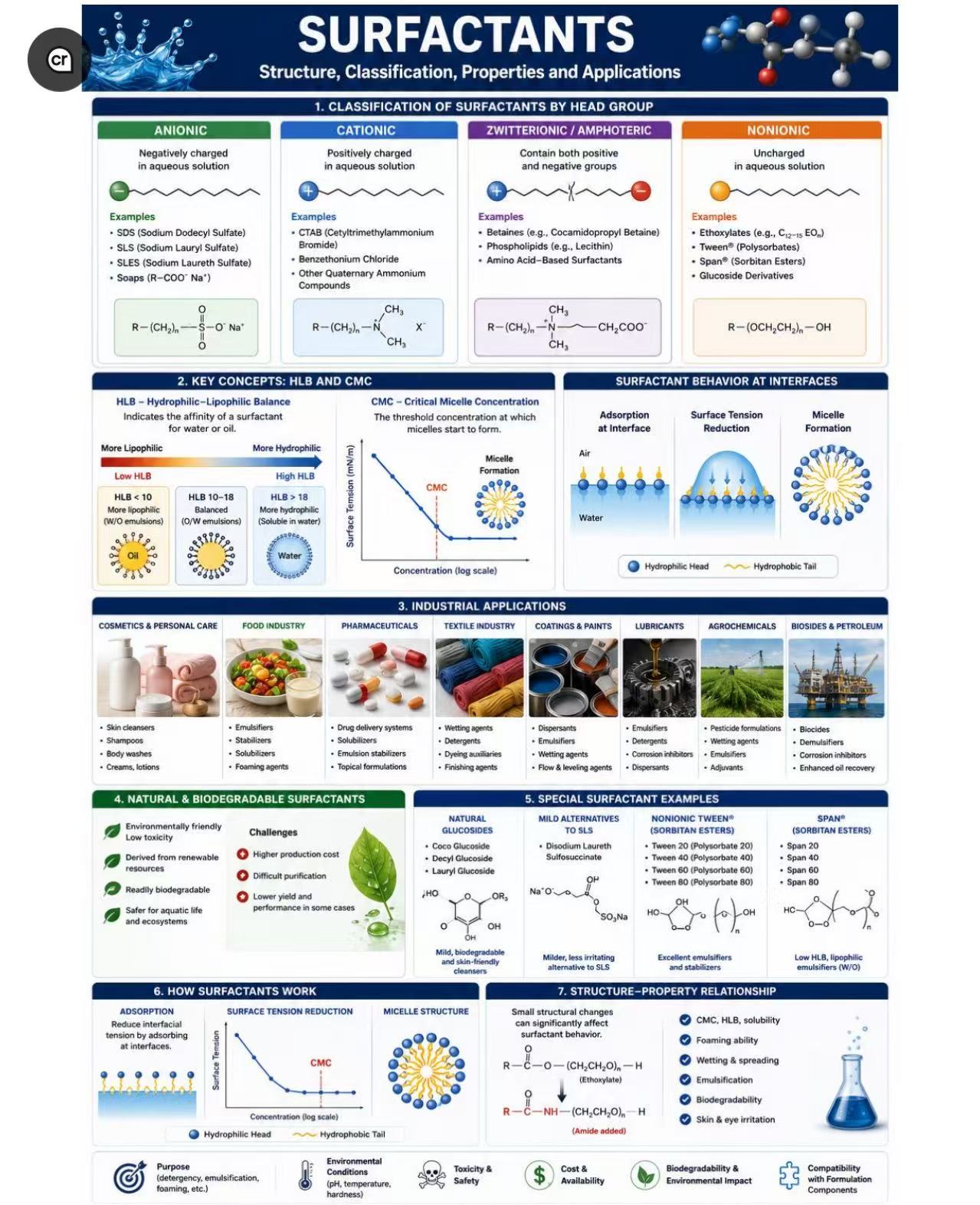
Surfactants are amphiphilic molecules, meaning they have a hydrophilic head and a hydrophobic tail.
Because of that structure, they gather at interfaces such as oil-water or air-water boundaries.
Their main effect is to lower surface tension and stabilize mixtures that would otherwise separate.
Main types
Anionic surfactants: negatively charged head groups; strong detergency.
Cationic surfactants: positively charged head groups; often antimicrobial and used on surfaces.
Nonionic surfactants: no charge; useful for compatibility and mildness.
Zwitterionic surfactants: contain both positive and negative charges in the same molecule; often low-irritation.
How they work
Surfactants align at interfaces so the hydrophobic part faces air or oil and the hydrophilic part faces water.
This arrangement weakens water-water cohesion at the surface, so surface tension drops.
At higher concentrations, they can form micelles, which help trap oily or hydrophobic substances.
Where they are used
Household detergents and cleaners.
Food products, cosmetics, and pharmaceuticals.
Textile processing, emulsions, suspensions, and oil recovery.
Foam control, corrosion inhibition, and dispersing pigments or dyes.
Why they matter
Surfactants make cleaning and mixing possible in systems where water and oil do not naturally combine.
They are also central to modern formulations in personal care, industrial chemistry, and materials science.
In many products, the choice of surfactant type strongly affects performance, irritation, stability, and environmental impact.
Post time: Jun-17-2026