

With the improvement of people’s living standards, consumers’ requirements for food are no longer limited to reasonable nutritional value. They also demand satisfactory sensory qualities of food, including appearance, color, aroma, taste, consistency and freshness.
As texture-modifying food additives, emulsifiers play a vital role in the food industry. Let’s take a look at the mechanism of action of emulsifiers!
Emulsions
Emulsions are widely present in foods. One phase consists of water or aqueous solutions, collectively referred to as the hydrophilic phase; the other phase is an organic phase immiscible with water, also known as the lipophilic phase. When two immiscible liquids such as water and oil are mixed, two types of emulsions can be formed, namely oil-in-water (O/W) emulsions and water-in-oil (W/O) emulsions. In oil-in-water emulsions, oil is dispersed in water as tiny droplets, with oil droplets serving as the dispersed phase and water as the continuous medium. Milk is a typical example of an O/W emulsion. Conversely, in water-in-oil emulsions, water is dispersed in oil as tiny droplets, where water acts as the dispersed phase and oil as the continuous medium, with margarine being a representative W/O emulsion.
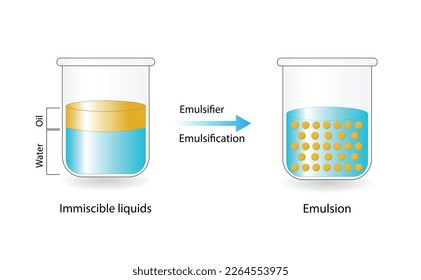
Mechanism of Action of Emulsifiers
Food emulsifiers, also called surfactants, are substances that convert immiscible liquids into uniformly dispersed emulsions. As food additives, they can significantly reduce the interfacial tension between oil and water phases after being incorporated into food, thereby forming stable emulsions from immiscible oil (hydrophobic substances) and water (hydrophilic substances).
On one hand, emulsifiers form thin molecular films at the mutually repellent interfaces of the two phases to lower the surface free energy of the entire system and generate new interfaces. Emulsifier molecules contain both hydrophilic and lipophilic groups, which can adsorb to the mutually repellent surfaces of oil and water respectively to form thin molecular layers and reduce the interfacial tension between the two phases. To be specific, oil molecules interact with the lipophilic segments of emulsifiers while water molecules interact with the hydrophilic segments of emulsifiers, and the interaction between these two sides alters the interfacial tension. On the other hand, emulsifiers form protective adsorption layers on the surface of tiny droplets, endowing the droplets with strong steric stabilization. Generally, a higher dosage of emulsifiers leads to a more substantial reduction in interfacial tension. This allows originally immiscible substances to blend uniformly and form a homogeneous dispersion system, which changes the original physical state, optimizes the internal structure of food, and improves food quality.
Hydrophilic-Lipophilic Balance Value
The hydrophilic-lipophilic balance (HLB) value: Emulsifiers with strong hydrophilicity generally form oil-in-water emulsions, while those with strong lipophilicity form water-in-oil emulsions. The HLB value is commonly adopted to characterize the hydrophilic-lipophilic balance of emulsifiers and quantify their hydrophilicity. Multiple calculation methods are available for HLB values:
Difference formula: HLB = Hydrophilicity of hydrophilic groups − Lipophobicity of lipophilic groups
Ratio formula: HLB = Hydrophilicity of hydrophilic groups / Lipophobicity of lipophilic groups
The HLB value of each emulsifier can be determined experimentally. It is stipulated that emulsifiers with 100% lipophilicity (represented by paraffin wax) have an HLB value of 0, and those with 100% hydrophilicity (represented by potassium oleate) have an HLB value of 20. The range between 0 and 20 is divided into 20 equal parts to indicate the strength of hydrophilicity and lipophilicity. A higher HLB value corresponds to stronger hydrophilicity, whereas a lower HLB value means stronger lipophilicity.
Most food-grade emulsifiers are nonionic surfactants with HLB values ranging from 0 to 20; the corresponding properties of nonionic emulsifiers with different HLB values are listed in the table. By contrast, ionic surfactants have HLB values spanning 0 to 40. Therefore, emulsifiers with HLB values below 10 are predominantly lipophilic, while those with HLB values equal to or above 10 exhibit hydrophilic characteristics.
For mixed emulsifiers, their HLB values are additive. Therefore, when two or more emulsifiers are used in combination, the HLB value of the mixed emulsifier can be calculated based on the mass fractions of each constituent emulsifier: HLBa,b = HLBa·A% + HLBb·B%
Where HLBa,b denotes the HLB value of the mixture of emulsifier a and emulsifier b; HLBa and HLBb represent the respective HLB values of emulsifier a and emulsifier b; A% and B% stand for the mass percentages of emulsifier a and emulsifier b in the mixed emulsifier (This formula is only applicable to nonionic emulsifiers).
Preparation Methods and Influencing Factors of Emulsifiers
There are four preparation methods for emulsifiers, namely the dry gum method, wet gum method, oil-water phase mixing method and mechanical method.
The dry gum method involves adding the aqueous phase to the oil phase containing emulsifiers. During preparation, gum powder (emulsifier) is first mixed evenly with oil, a certain amount of water is added, and the mixture is ground and emulsified into primary emulsion, followed by adding water to dilute to the full volume. The wet gum method means adding the oil phase to the aqueous phase containing emulsifiers. In preparation, gum (emulsifier) is first dissolved in water to make gum mucilage as the aqueous phase; then the oil phase is added to the aqueous phase in batches and ground into primary emulsion, after which water is supplemented to the full volume. The oil-water phase mixing method refers to mixing a certain amount of oil and water, grinding acacia gum fine in a mortar, adding the oil-water mixture into it to rapidly grind into primary emulsion, and then diluting with water.
The preparation of emulsifiers mainly aims to emulsify two kinds of liquids, and the emulsification effect exerts a great impact on the quality of emulsions. The main factors affecting emulsification include interfacial tension, viscosity and temperature, emulsification time, and dosage of emulsifiers. Generally, emulsifiers that can significantly reduce interfacial tension are selected. The optimal emulsification temperature for emulsifiers is about 70°C; if nonionic surfactants are used as emulsifiers, the emulsification temperature shall not exceed their cloud point. Generally speaking, the higher the dosage of emulsifiers, the more stable the formed emulsions will be.
Post time: Jul-21-2026