

Wetting occurs when a solid comes into contact with a liquid. The original solid-gas and liquid-gas interfaces disappear, and a new solid-liquid interface is formed. For example, textile fibers are porous materials with a large specific surface area. When a solution spreads along the fibers, it penetrates the gaps between fibers and displaces air, turning the original air-fiber interface into a liquid-fiber interface — this is a typical wetting process. Meanwhile, the solution permeates into the interior of the fibers, a process known as penetration. Surfactants that facilitate wetting and penetration are called wetting agents and penetrating agents respectively.
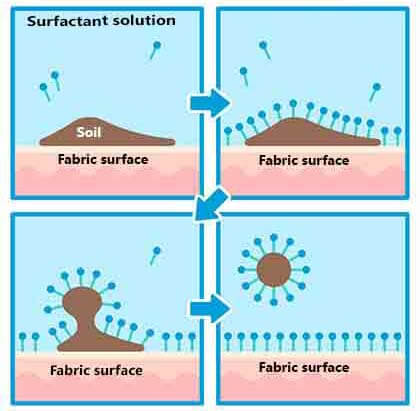
Oils have high surface tension in water. When oil is added to water and the mixture is stirred vigorously, the oil breaks into fine droplets to form an emulsion, yet the mixture will separate into layers again once stirring stops. If a surfactant is added and the mixture is stirred, the layers will not separate easily for a long time after stirring ceases, which is emulsification. The hydrophobic part of oil molecules is surrounded by the hydrophilic groups of surfactants, creating directional attractive forces. This reduces the energy required to disperse oil in water and achieves effective emulsification of oils.
Thanks to the emulsifying effect of surfactants, oil and dirt particles detached from solid surfaces can be stably emulsified and dispersed in aqueous solutions, preventing them from redepositing on cleaned surfaces and causing recontamination.
Dispersion refers to the process in which insoluble solids are distributed in a solution as tiny particles to form a suspension. Surfactants that enhance the dispersion of solids and maintain stable suspensions are termed dispersants. In practice, it is difficult to distinguish emulsification from dispersion when semi-solid oils are emulsified and dispersed in solutions. Since emulsifiers and dispersants are usually the same type of substance, they are collectively referred to as emulsifier-dispersants in practical applications.
Solubilization means that surfactants can increase the solubility of sparingly soluble or insoluble substances in water. For instance, the solubility of benzene in water is 0.09% by volume. After adding surfactants such as sodium oleate, the solubility of benzene can rise to 10%.
Solubilization is closely related to micelles formed by surfactants in water. A micelle is an aggregate formed when the hydrocarbon chains of surfactant molecules draw close to one another in an aqueous solution due to hydrophobic interactions. The interior of a micelle is essentially liquid hydrocarbons, so non-polar organic solutes that are insoluble in water, such as benzene and mineral oil, can readily dissolve inside micelles. Solubilization is the dissolution of lipophilic substances by micelles, a unique property of surfactants. It only takes effect when the surfactant concentration in the solution exceeds the critical micelle concentration (CMC), namely when a large number of large micelles exist. In addition, larger micelles provide greater solubilization capacity.
Solubilization differs from emulsification. Emulsification produces a discontinuous and unstable multiphase system where one liquid phase is dispersed in water or another liquid phase. In contrast, solubilization results in a homogeneous, stable single-phase system where the solubilizing solution and the solubilized substance exist in the same phase. A single type of surfactant may possess both emulsifying and solubilizing properties, but solubilization only occurs when its concentration is above the critical micelle concentration.
When surfactant molecules align directionally on fabric surfaces, they reduce the coefficient of static friction of fabrics. Nonionic surfactants such as linear alkyl polyoxyethylene polyols and linear alkyl fatty acid polyoxyethylene ethers, as well as various cationic surfactants, can lower the static friction coefficient of fabrics and thus serve as fabric softeners. However, surfactants with branched alkyl or aromatic groups fail to form an orderly directional arrangement on fabric surfaces and are therefore unsuitable for use as softeners.
Post time: Jun-10-2026